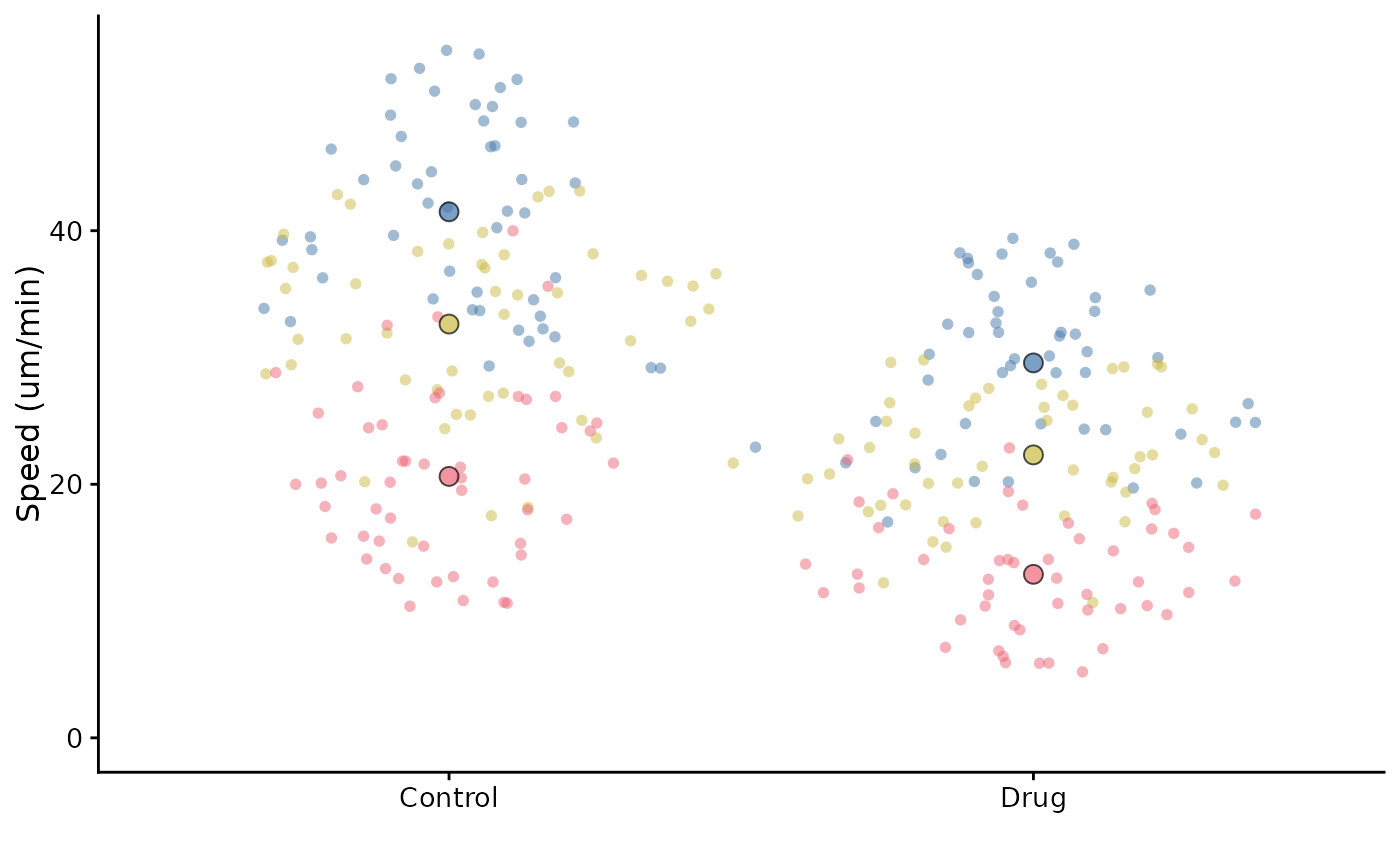
The function superplot() creates a SuperPlot using ggplot2.
Usage
superplot(
  df,
  meas,
  cond,
  repl,
  facet = NULL,
  pal = "tol_bright",
  xlab = "",
  ylab = "Measurement",
  datadist = "sina",
  size = c(2, 3),
  alpha = c(0.5, 0.7),
  bars = "mean_sd",
  linking = FALSE,
  rep_summary = "rep_mean",
  shapes = FALSE,
  fsize = 12,
  gg = NULL,
  stats = FALSE,
  stats_test = "para_unpaired",
  info = FALSE,
  options = NULL
)
Arguments
- df
data frame with at least three columns: meas, cond, repl
- meas
character name of column with measurement (e.g. intensity)
- cond
character name of column with condition (e.g. Control, WT)
- repl
character name of column with replicate (e.g. unique experiment identifiers)
- facet
character name of column to facet by (default is NULL)
- pal
name of colour palette to use (default is "tol_bright")
- xlab
string for x label (default is empty)
- ylab
string for y label (default is "Measurement")
- datadist
string for data distribution to use, select ("sina" default, "jitter", or "violin")
- size
numeric vector of size range data and summary points (default is c(2, 3))
- alpha
numeric vector of alpha range data and summary points (default is c(0.5, 0.7))
- bars
string for type of error bars to add, select "mean_sd" (default), "mean_sem", or "mean_ci"; for no bars use an empty string (""); for no error bars but still show the mean with a crossbar, use "none".
- linking
logical for whether to link summary points between conditions (default is FALSE)
- rep_summary
string for summary statistic to use for replicates, select ("rep_mean" default, or "rep_median")
- shapes
logical for whether to use different shapes for replicates
- fsize
numeric font size for text (default is 12)
- gg
ggplot object to add to (default is NULL)
- stats
logical for whether to add statistical tests (default is FALSE)
- stats_test
string for statistical test to use, select ("para_unpaired", "para_paired", "nonpara_unpaired", or "nonpara_paired")
- info
logical for whether to print information about the plot (default is FALSE)
- options
optional named list for advanced layer customization. See
superplot_spec()andsp_modify()for available options.